
How to Homeschool for the Junior Cert in Ireland
Home-educated children in Ireland are not required to sit the Junior Cert. Here's what the Junior Cycle framework actually says, what the eight Key Skills are in plain language, and how everyday life already covers them.
You don't have to. Home-educated children in Ireland are not required to sit the Junior Cert. The legal requirement is to provide "a certain minimum education" — assessed by Tusla, not by the State Examinations Commission.
The Junior Cycle framework is still worth knowing about. Not because it's required, but because it describes what second-level education is meant to develop — and it's more straightforward than most parents expect.
Do home-educated children in Ireland have to sit the Junior Cert?
No. The Junior Certificate is a school examination run by the State Examinations Commission. Home-educated children are registered with Tusla under Section 14 of the Education (Welfare) Act 2000, not with the examination system.
Tusla's job is to assess whether your child is receiving "a certain minimum education." That assessment looks at broad development — intellectual, physical, social, moral, personal — not at whether specific subjects have been covered or whether exams have been sat.
Citizens Information has a clear overview of the registration process if you're starting out. For what a Tusla assessor actually looks at, what Tusla wants in a home education assessment covers it in detail.
What the Junior Cycle framework actually is
The Junior Cycle framework is an NCCA document that describes what three years of second-level education should develop in a young person. Schools use it to design their programmes. Home educators can use it as a reference.
Download the Junior Cycle Framework PDF
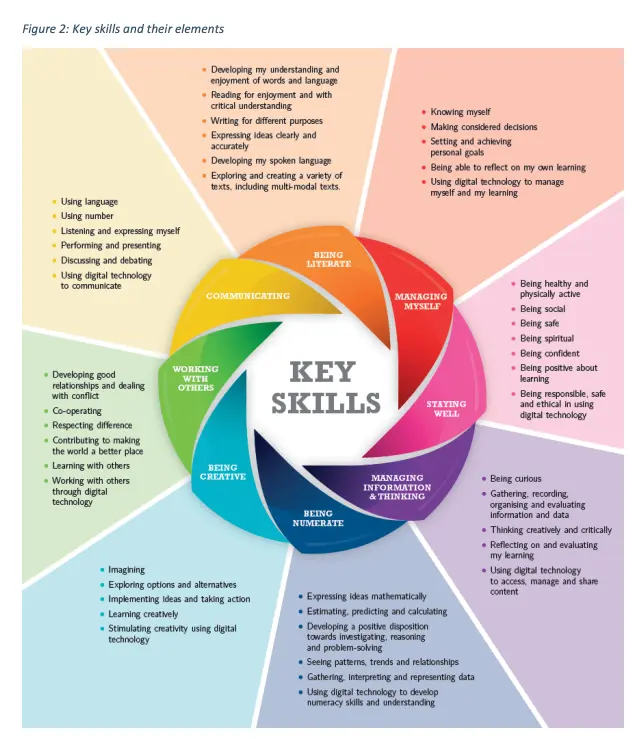
The framework is built around eight Key Skills — capacities the document says every young person should be developing. These are not subjects. They're broader than any timetable.
The document runs to 55 pages, most of it guidance for schools. The Key Skills section is what home educators actually need.
The eight Key Skills, in plain language
Being Literate — reading, writing, speaking, and making sense of different kinds of text. Not just books: instructions, arguments, digital content, any written thing.
Managing Myself — knowing your own way of learning, setting goals, reflecting on how things went. Self-awareness as something you can practise and develop.
Staying Well — physical health, mental health, safety, confidence, and taking care of yourself.
Managing Information & Thinking — asking questions, gathering information, thinking critically, evaluating what you find. Curiosity with some discipline behind it.
Being Numerate — working with numbers, patterns, data, estimation. Everyday maths, not school maths.
Being Creative — generating ideas, trying things out, making things happen, learning from what goes wrong. Not limited to art.
Working with Others — collaboration, conflict, difference, contributing to something beyond yourself.
Communicating — expressing ideas in different ways, listening, discussing, presenting.
These are developmental capacities. A teenager develops them through how they spend their time, not through which textbooks they use.
Why you don't need a curriculum to cover them
A curriculum is one way to develop these capacities. It isn't the only way.
For many home-educated teenagers — particularly those who are neurodivergent, who have left school after a difficult period, or who learn best through interest and immersion — following a curriculum is actively the wrong tool. It reintroduces the structure that wasn't working in school.
Tusla doesn't assess curriculum completion. Their assessment looks at whether broad development is happening across the areas they're responsible for.
The eight Key Skills map onto those areas well. An assessor looking for evidence that a teenager is intellectually engaged, physically active, socially connected, and developing as a person will find that evidence in a well-documented home education — curriculum or not.
Documenting it is the part that needs deliberate effort.
What this looks like in everyday life
A teenager cooking from scratch is using Being Numerate — scaling a recipe, reading temperatures, understanding quantities — and Being Creative. Two Key Skills in one afternoon.
A teenager following a deep interest, whatever it is: game development, music production, a YouTube channel, horses, coding, a language they've decided they want to learn. That kind of sustained engagement covers Managing Information & Thinking, Being Creative, and usually Being Literate and Communicating as well. The depth of the interest matters more to an assessor than the topic.
A part-time job, a volunteering role, or a drama group covers Working with Others and Communicating in a way a classroom rarely does as cleanly. These are also the activities that come up naturally at a Tusla review when the assessor asks about your teenager's social life.
Managing their own schedule and knowing when they need rest is Managing Myself and Staying Well. You can't timetable these. They develop through ordinary life.
We went to see Macbeth this year. My daughter had never encountered it — I told her nothing beforehand — and she came out knowing the plot, the characters, and what the witches actually meant. She'd watched it happen in front of her, with real people, in real time. On the way home we talked about what Macbeth had been thinking when he made each decision. It was the same play I'd studied for my own Junior Cert. She got more from two hours in a seat than I did from a term of classroom notes.
When I logged it afterwards, I tagged it across three Key Skills. Being Literate: theatre is literature performed; following dialogue in real time is reading comprehension applied to a live medium. Communicating: the conversation on the way home, what a character was thinking, what the ending meant. Managing Information & Thinking: making sense of period language, working out meaning from context.
The Junior Cycle wasn't designed around the assumption that teenagers only learn between 9am and 3pm in a classroom.
If your teen does want to sit the Junior Cert
They can. Home-educated students can register as external candidates for the Junior Certificate through the State Examinations Commission.
The process involves finding an approved exam centre willing to take external candidates, registering before the published deadline (usually November for the following June), and paying the entry fees per subject. Some centres take external candidates readily. Others don't. It takes some research.
If this is something your teenager wants, start looking into it 18 months before the planned sitting. The key question is whether there's a willing centre in your area — that determines everything else.
The thing to avoid is letting the possibility of sitting exams become the driver of your whole home education. A teenager who wants to take two or three subjects doesn't need a school-replication programme at home. They need focused preparation for those subjects, while the rest of their time continues as it was.
For the broader question of secondary-level alternatives, unschooling vs secondary school looks at both options honestly.
How to show Tusla you're covering enough — without doing exams
Tusla assesses development. Exam results aren't part of it.
The eight Key Skills are a useful frame for gathering that evidence. When you note a learning moment — a project, a conversation, a book, an activity — it's worth tagging which of the eight areas it connects to. Over a year, that builds a picture of broad engagement that an assessor can see quickly.
What works at a Tusla review:
- A written education plan — one page, plain language — describing your approach and what a typical week looks like.
- Photos or descriptions of things your teenager has been doing, with brief context for each.
- Something that shows a current deep interest, properly resourced. A book, a project, a course, or a person they've been learning from.
- Honest acknowledgement of any gaps, with a note about what you're doing about it.
The standard is a teenager who is intellectually engaged, socially active, physically developing, with a parent who is clearly paying attention. For the practical preparation side, how to prepare for a Tusla home education assessment is the place to start.
Keeping a record without turning life into school (and how Sustenance helps)
The practical problem with home education without a curriculum is this: life is full of learning, and most of it passes undocumented. That's fine day to day. At a Tusla review, you need to be able to show something.
Sustenance is a logging app built for this. The focus areas in the app are the eight Junior Cycle Key Skills — so when you log a moment, you're tagging it against the same framework this post describes. Over time, the log becomes an evidence base that maps directly to what an assessor is looking for.
It was built by a home-educating parent of neurodivergent children who couldn't find anything that fit how our days actually work. If that sounds familiar, you can join the early list at sustenance.family.
Frequently asked questions
Do home-educated children in Ireland have to do the Junior Cert?
No. Home-educated children in Ireland are registered with Tusla under Section 14 of the Education (Welfare) Act 2000. Tusla assesses whether they are receiving "a certain minimum education" — not whether they have sat specific exams. The Junior Certificate is a school examination and is not required of home-educated children.
What is the Junior Cycle framework, and where can I find it?
The Junior Cycle framework is an NCCA document that describes what second-level education should develop in young people. It is built around eight Key Skills: Being Literate, Managing Myself, Staying Well, Managing Information & Thinking, Being Numerate, Being Creative, Working with Others, and Communicating. Home educators can use it as a reference point. Download the framework PDF.
Do I need to follow a curriculum to home-educate a teenager in Ireland?
No. There is no legal requirement to follow a curriculum. Tusla assesses broad development across intellectual, physical, social, moral, and personal areas — not curriculum completion. A well-documented home education that covers the eight Junior Cycle Key Skills through everyday life, projects, and real-world activity meets the standard without a curriculum.
Can a homeschooled teen still sit the Junior Cert if they want to?
Yes. Home-educated students can register as external candidates for the Junior Certificate through the State Examinations Commission. The practical requirement is finding an approved exam centre willing to take external candidates. Start researching at least 18 months before the planned exam sitting.
How do I show Tusla we're covering enough if we're not following a curriculum?
Keep a record of what your teenager does — photos, notes, descriptions of projects and interests — and organise it loosely by the eight Key Skills. Write a one-page education plan describing your approach. At a Tusla review, an assessor wants to see that learning is happening and that you are aware of your child's development. Evidence of broad engagement, documented as you go, is what counts.
Frequently asked questions
- No. Home-educated children in Ireland are registered with Tusla under Section 14 of the Education (Welfare) Act 2000. Tusla assesses whether they are receiving "a certain minimum education" — not whether they have sat specific exams. The Junior Certificate is a school examination and is not required of home-educated children.
- The Junior Cycle framework is an NCCA document that describes what second-level education should develop in young people. It is built around eight Key Skills — Being Literate, Managing Myself, Staying Well, Managing Information and Thinking, Being Numerate, Being Creative, Working with Others, and Communicating. Home educators can use it as a reference point. Download the framework PDF at ncca.ie/media/3249/framework-for-junior-cycle-2015-en.pdf.
- No. There is no legal requirement to follow a curriculum. Tusla assesses broad development across intellectual, physical, social, moral, and personal areas — not curriculum completion. A well-documented home education that covers the eight Junior Cycle Key Skills through everyday life, projects, and real-world activity meets the standard without a curriculum.
- Yes. Home-educated students can register as external candidates for the Junior Certificate through the State Examinations Commission. The practical requirement is finding an approved exam centre willing to take external candidates. Start researching at least 18 months before the planned exam sitting.
- Keep a record of what your teenager does — photos, notes, descriptions of projects and interests — and organise it loosely by the eight Key Skills. Write a one-page education plan describing your approach. At a Tusla review, an assessor wants to see that learning is happening and that you are aware of your child's development. Evidence of broad engagement, documented as you go, is what counts.