Sustenance
Being first. Doing follows.
A private home for families raising a PDA (demand avoidant) child. One calm space for your child, one quiet record for you.
For home-educating families raising a PDA (demand avoidant) child, and for autistic, ADHD, AuDHD and 2e kids too.
Built by one family who lives this, and designed with our own neurodivergent kids.
Free to join, no card needed. No scoring. No AI talking to your child.
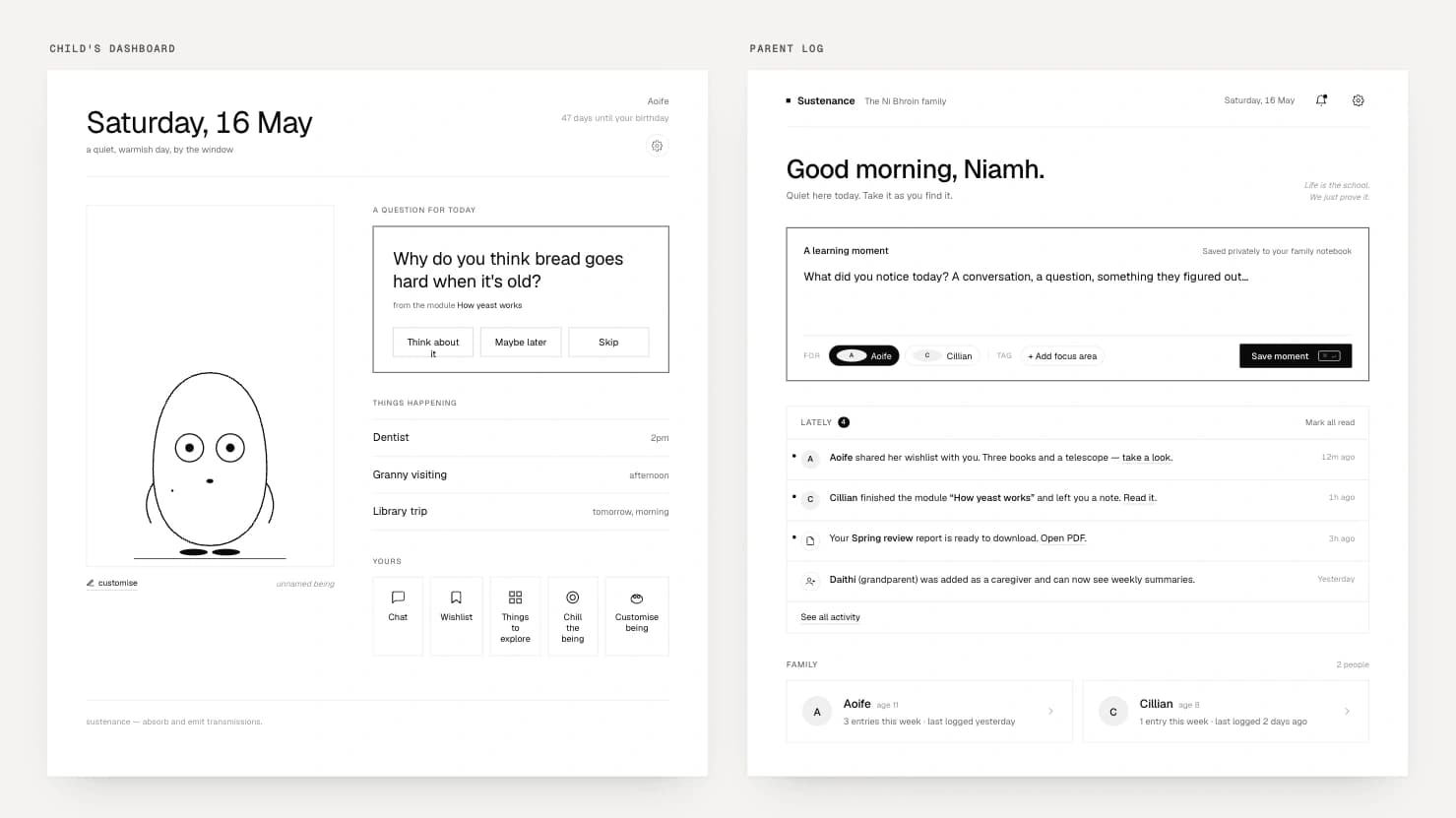
You’re already doing the work. You just can’t prove it.
The learning is everywhere. In the questions at breakfast. In the thing they figured out on the floor while you weren’t looking.
But it’s scattered across your camera roll, three notebooks and a group chat. And when someone official asks what you’ve been doing all year, your stomach drops.
Meanwhile every app you’ve tried makes it worse. Streaks. Points. Badges. A green tick that turns learning into one more demand your child recoils from.
That’s the thing nobody built for. So I did. My own neurodivergent kids told me what would actually work, and what to throw out.
01Strew, then notice.
You don’t teach at them. You leave things in their path and see what they pick up.
A book left open on the table. A documentary on in the background. A bag of clay on the counter that nobody mentions. That’s strewing, and for a demand-avoidant child it is often the only thing that works.
Then you notice. The question they asked. The thing they wouldn’t let go of for three weeks. The noticing is the whole method, and it’s the part no app was ever built for.
02You notice everything. Now it counts.
Write down what you saw. A conversation, a question, something they worked out. Tag it to a focus area and move on.
It takes ten seconds. You can do it later, from your phone, with a photo and one line. No forms. No guilt about the days you forgot.
It builds up quietly, on its own, until you have a whole picture without ever having sat down to “do the records.”
Because you write it down as it happens, there’s no scramble to retrofit a year of evidence in the week before a review.
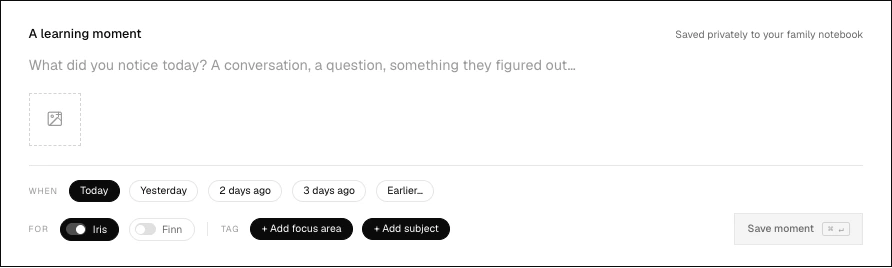
03The eight focus areas.
Every moment gets tagged to a focus area. Being literate. Being numerate. Managing myself. Staying well. Managing information and thinking. Being creative. Working with others. Communicating.
They’re the Junior Cycle Key Skills, the framework Irish second-level education is built on. You’re not inventing categories. You’re using the ones a reviewer already knows.
They travel. A reviewer in the UK, the EU, Australia or New Zealand reads “working with others” and knows exactly what it means.
Eight skills, not a curriculum. Broad on purpose, so a term of ordinary life fits inside them without being bent into a timetable.
04Subjects, if you want them.
Some reviewers want the school-shaped view. There’s a second tag for that: science, mathematics, English, Gaeilge, languages, history, geography, art, music, coding, philosophy, PE, wellbeing, home economics.
It’s optional. Tag a moment with both, one, or neither.
Sourdough on a Tuesday is science and home economics. It’s also being numerate and managing myself. Same moment, two ways to read it, depending on who’s asking.
05Bring in another adult.
A co-parent. A grandparent. A tutor, a babysitter, an SNA, anyone else who spends real time with your child.
You invite them and you choose what they get. A tutor sees only the children you’ve granted them. They log their own sessions and can only edit what they wrote themselves. They can’t read your family’s log.
So the person who takes your child to the woods on a Thursday writes down what happened, and it lands in your record without you having to remember to ask.
They also arrive knowing something. Each child has a card the family writes: what helps, what to go gently with, safe snacks only, and what to do if a session gets hard. Nobody should be finding that out the hard way at ten in the morning.
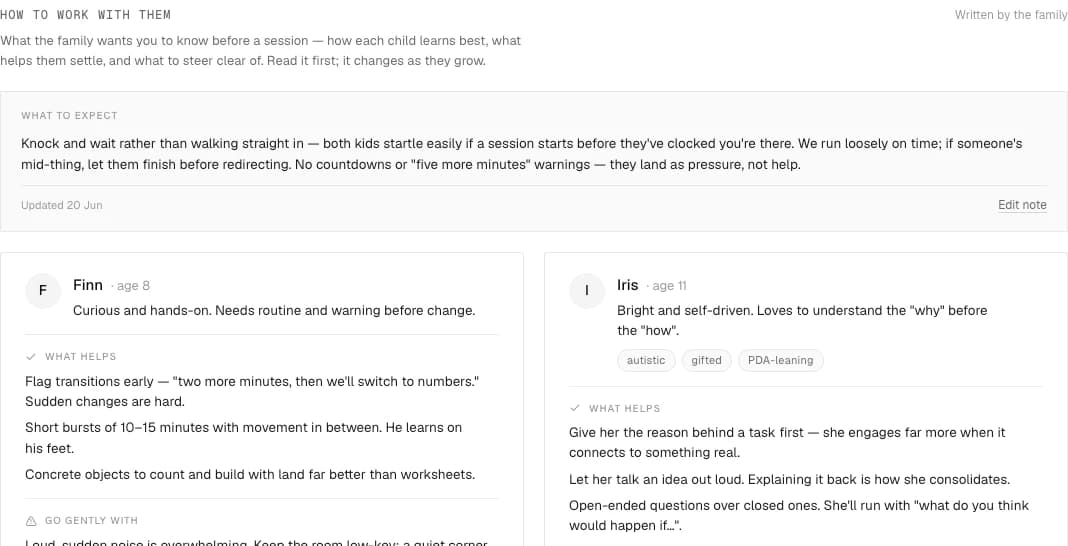
06Proof, for the day someone asks.
Wherever you home-educate, someone eventually wants to see it: an assessor, a reviewer, an education officer, or just you, wanting the whole picture.
Generate a report by child, date range, or focus area. It shows that real learning is happening, without pretending to be school.
You choose who it’s about, the date range, and which focus areas. Then every single moment has a checkbox. Anything you’d rather not hand over, you leave out.
You also choose what it’s for. An assessor review, a personal record for the family, or something custom for a tutor or a specialist. The framing changes with it.
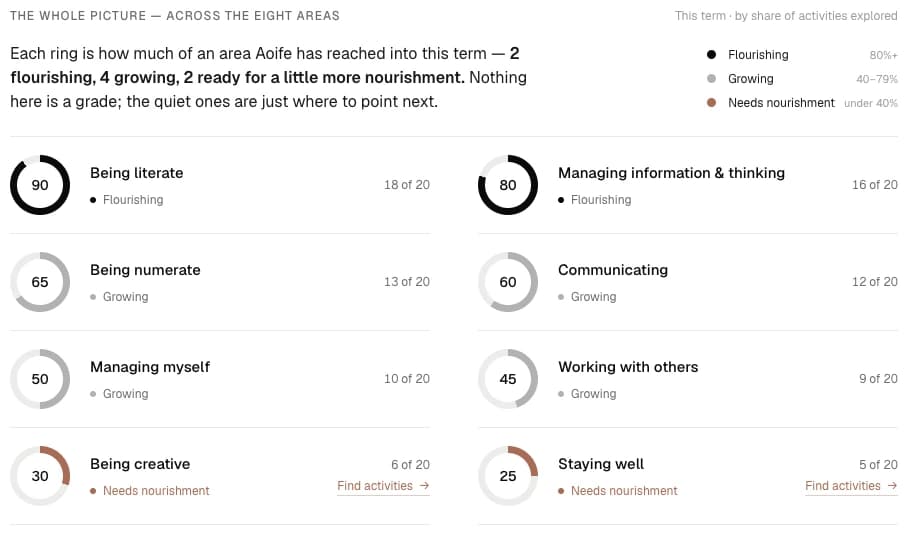
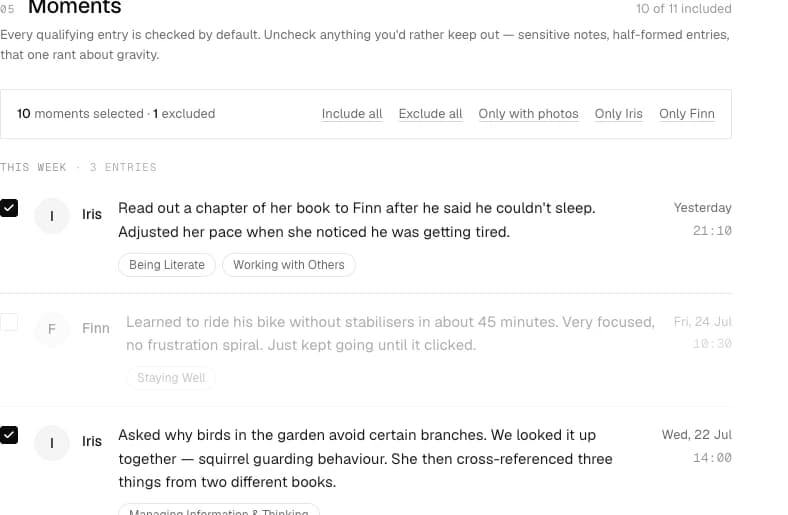
07What the assessor actually gets.
A cover sheet with the dates and your child’s name. A short narrative summary. Then the moments, grouped by focus area, in the order they happened.
It doesn’t pretend to be school. It shows a real year of a real child, in your words, with dates that hold up.
A whole term of ordinary moments, gathered into something you can hand over with your shoulders down.
08A place that asks nothing of them.
Their own dashboard. A companion creature they name and make their own. What’s happening today, if they want to look.
A daily question they can think about, or skip, with no penalty, because a question they must answer is just another demand.
Low-demand by design. No streaks. No points. No badges. Nothing to earn. Their side of the app will never make them perform for it.
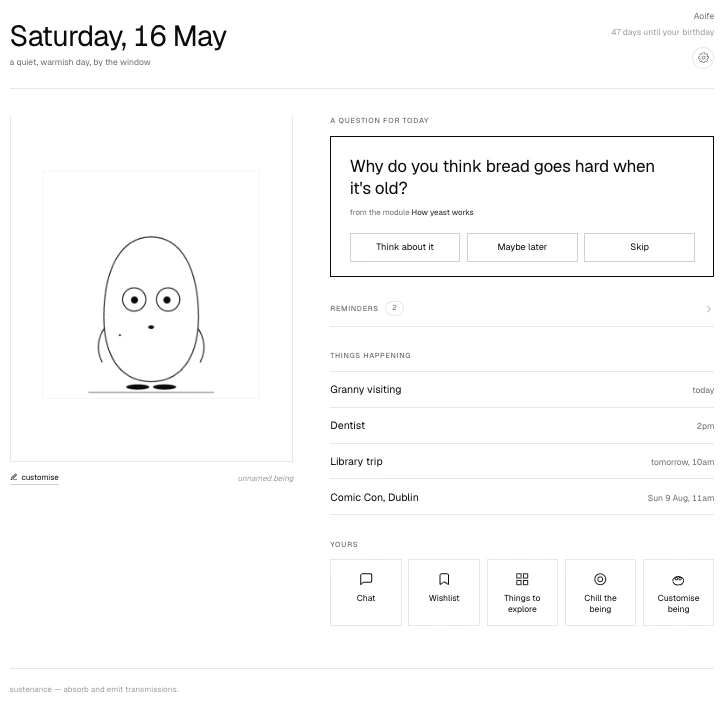
09Their space is theirs. And no AI ever speaks to them.
The child’s side is never tracked, never scored, never marked. It isn’t a window for you to watch them through.
AI never talks to your child. That space is made by humans, for a human.
For a lot of us, the relationship needs repairing before anything else can happen. This is built for that. Safe first. Learning follows.
10What’s yours stays yours.
Everything is scoped to your family. Sensitive fields are encrypted. Nothing is sold, shared, or fed to a public feed.
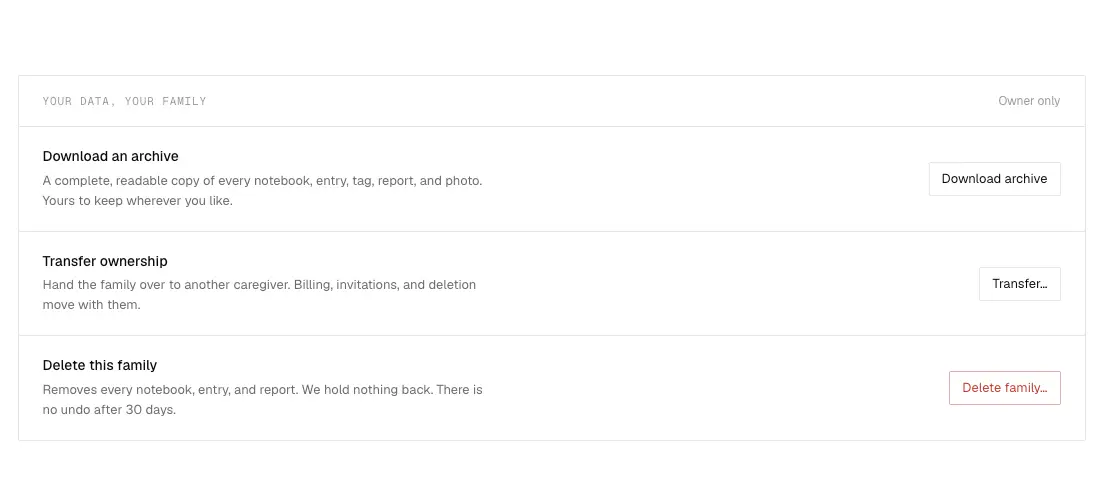
You can export everything, any time, in a format you keep. If you ever leave, your child’s record leaves with you.
A software engineer who home-educates her own children.
I build software for a living, and I home-educate my neurodivergent twins. This is the app I needed for both.
I went looking for an app that recorded their learning without turning them into a scoreboard, and it didn’t exist. Everything either ignored the nervous system or gamified it into the ground.
So I made the thing I needed, and my kids made it with me. They told me what to put in and what would never work for a brain like theirs. Every “no” from them made it better.
Sustenance is built by one family, for families like mine. Not by a company that will sell your child’s data the moment it needs to grow.
Sonia
Founding families
The first 100 families.
Reserving is free. Answer a few quick questions and hold your place — it just tells me you’re real.
The first 100 families lock in €9 a month, or €90 a year, held for as long as you stay. After that, Sustenance is €15 a month. Founding is the lowest price it will ever be.
You choose whether to continue when it opens. Cancel any time.
Founding families get more than a price. You’ll get updates as it’s built, a look behind the scenes, and a real say in what comes next. The features you help shape are the ones I build first.
Sustenance is in active development, built in the open, for the community it’s for.
There’s more in it than this.
Sustenance is bigger than the log and the report. Some of this is already in there. Some is next.
Already in there
A wishlist, with pictures, and a budget. Your child adds what they want and what it costs. You set a budget for a birthday, and the guessing stops.
Family chat. Private to your family. It never touches the log.
A breathing helper. For anxiety, and for the long gap before sleep.
The first learning drops. Things they can open if they want to, and ignore if they don’t.
Being built next
Life skills. Cooking a real meal. Finding your way. Writing a real letter. Handled gently, before they’re needed.
More modules, chosen for what a PDA child actually needs to know. How the nervous system works, explained for the person living in one. The origin of words. French.
Food-intake notes. For ARFID families. Safe foods, what’s holding, what’s dropped off. Recorded quietly, with nothing attached to it.
Founding families get a real say in the order these arrive, and can add requests of their own for whatever would actually help.
Frequently asked questions
- What is Sustenance?
- Sustenance is a private app for home-educating families raising a PDA (demand avoidant) child, and neurodivergent families more broadly. A learning log and reporting tool for parents, and a low-demand learning environment for children: no streaks, no scores, no demand-loaded prompts.
- Who is Sustenance for?
- Home-educating parents in review-based jurisdictions: Ireland, the UK, the EU, Australia, and New Zealand. With a particular fit for families raising a PDA (pathological demand avoidance) child, and for autistic, ADHD and twice-exceptional kids too.
- Is Sustenance available now?
- Sustenance is in active development. The first 100 families lock in €9 a month, held for as long as they stay. Reserving a founding place is free. Hold a place above.